
By Wendy Rollin
Held by Faith: Christian Media
Now that the fireworks have faded and the Fourth of July celebrations have ended, the word freedom is still worth sitting with.
This year, as America marks the 250th anniversary of the adoption of the Declaration of Independence, many have paused to think about liberty, sacrifice, independence, and the freedoms we are blessed to have as a nation.
We hear it in patriotic songs.
We see it in flags.
We watch fireworks light up the sky as families gather, communities celebrate, and a country remembers the cost of freedom.
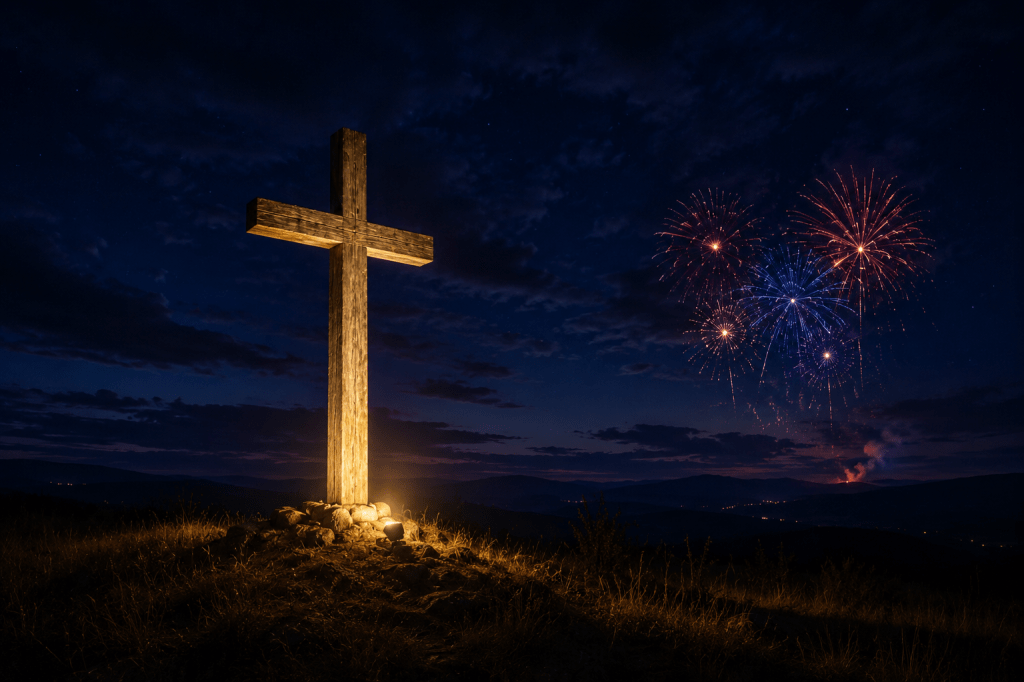
A cross illuminated beneath the night sky as fireworks fade in the distance, reflecting the greater freedom found in Jesus Christ.
But after the celebrations end, another kind of freedom remains worth thinking about. Our nation recognizes and protects religious liberty, and that is something to be grateful for. But the freedom Jesus provides reaches even deeper — it is a freedom no earthly power can give.
The Bible speaks of freedom in a way that reaches beyond laws, borders, and earthly circumstances. It reaches the soul. Jesus said in John 8:36, “If the Son therefore shall make you free, ye shall be free indeed.”
That kind of freedom is not temporary. It is not dependent on circumstances. It is not taken away by hardship, grief, persecution, disappointment, or the brokenness of the world.
The freedom Jesus gives releases us from the power of sin, from condemnation, from shame, from believing our past has the final word, and from the fear that death has the final victory.
Romans 8:1 says, “There is therefore now no condemnation to them which are in Christ Jesus.”
That is not just comforting.
That is life-changing.
Jesus does not offer freedom by pretending sin does not matter. He offers freedom because He paid the price for it. On the cross, Jesus carried what we could not carry. He took the weight of sin, shame, and separation from God. Through His death and resurrection, He opened the way for us to be made right with God.
But one of the most sobering truths in Scripture is that Jesus does not force anyone to receive Him.
He invites.
He calls.
He knocks.
But He does not make the decision for us.
Jesus said in Matthew 11:28, “Come unto me, all ye that labour and are heavy laden, and I will give you rest.” Revelation 3:20 also gives a powerful picture of Christ standing at the door and knocking. He comes near, but He does not break the door down. He gives us the freedom to respond.
From the beginning, God has allowed people to choose.
In Deuteronomy 30:19, God says, “I have set before you life and death, blessing and cursing: therefore choose life.” In Joshua 24:15, Joshua tells the people, “Choose you this day whom ye will serve.”
Those words still call us to a decision today.
Every person is given a choice. We can choose to follow Christ, or we can choose to turn away. We can choose surrender, or we can choose self. We can choose the narrow road, or we can choose the way that seems easier in the moment.
God allows us to respond freely, but Scripture reminds us that our choices are not meaningless.
Romans 6:23 says, “For the wages of sin is death; but the gift of God is eternal life through Jesus Christ our Lord.”
Eternal life is called a gift. A gift cannot be earned. It cannot be purchased by good works, religious appearances, or trying to be “good enough.” Salvation is by grace through faith in Jesus Christ.
But a gift still must be received.
That is where true freedom becomes deeply personal.
Jesus offers freedom, but we must decide what we will do with Him. We must decide whether we will believe Him, trust Him, follow Him, and surrender our lives to Him. What we do with Jesus is the most important decision we will ever make, and Scripture shows that our response to Him carries eternal significance.
That should humble us.
It should also awaken us.
Freedom in Christ is not permission to live any way we want. Galatians 5:1 says, “Stand fast therefore in the liberty wherewith Christ hath made us free.” But later in that same chapter, Scripture warns believers not to use liberty as an opportunity for the flesh.
In other words, Jesus sets us free so we can live for Him — not so we can remain bound to the very things He died to rescue us from.
True freedom is not doing whatever we want.
True freedom is being released from the chains that kept us from becoming who God created us to be.
It means we can repent and be forgiven.
We can begin again.
We can walk in truth instead of shame.
We can live with hope instead of fear.
And we can know that this world is not the end.
As Americans reflect on liberty, independence, and the freedoms we are blessed to have, Christians are also reminded of an even greater freedom — one secured not by a battlefield, but by a cross.
The freedom Jesus provides reaches beyond one nation, one generation, or one moment in history. It is offered to every person who will come to Him.
Scripture tells us in 2 Peter 3:9 that the Lord is “not willing that any should perish, but that all should come to repentance.”
The question is not whether Jesus is willing to save.
The question is whether we will receive the freedom He offers.
The fireworks fade. The celebrations end. Even the freedoms we cherish in this life are temporary compared to the eternal freedom found in Christ.
Because when the Son sets you free, no chain has the final word.
Biblical References on Freedom in Christ
John 8:36 — Freedom through the Son
Romans 8:1 — No condemnation in Christ
Matthew 11:28 — Jesus invites the weary to come to Him
Galatians 5:1 — Stand firm in liberty
Romans 6:23 — Eternal life through Jesus Christ
Deuteronomy 30:19 — Choose life
Joshua 24:15 — Choose whom you will serve
Revelation 3:20 — Jesus stands at the door and knocks
2 Peter 3:9 — God’s desire that all come to repentance


Leave a Reply