
Hezekiah’s Tunnel: When an Ancient Waterway Meets the Biblical Record
An ancient passage beneath Jerusalem brings archaeology, engineering, and Scripture into the same story.
By Wendy Rollin
Water still moves through the darkness beneath Jerusalem.
The stone passage bends unexpectedly, its limestone walls bearing the marks of tools used nearly 2,700 years ago. In places, it is narrow enough for those walking through it to touch both sides. Without modern drilling or surveying equipment—or electric light—ancient workers carved a winding waterway more than a third of a mile through bedrock.
Today, the passage is commonly known as Hezekiah’s Tunnel, or the Siloam Tunnel. It carries water from the Gihon Spring toward the Pool of Siloam area, connecting places central to Jerusalem’s biblical landscape.
This is where the stones begin to speak.
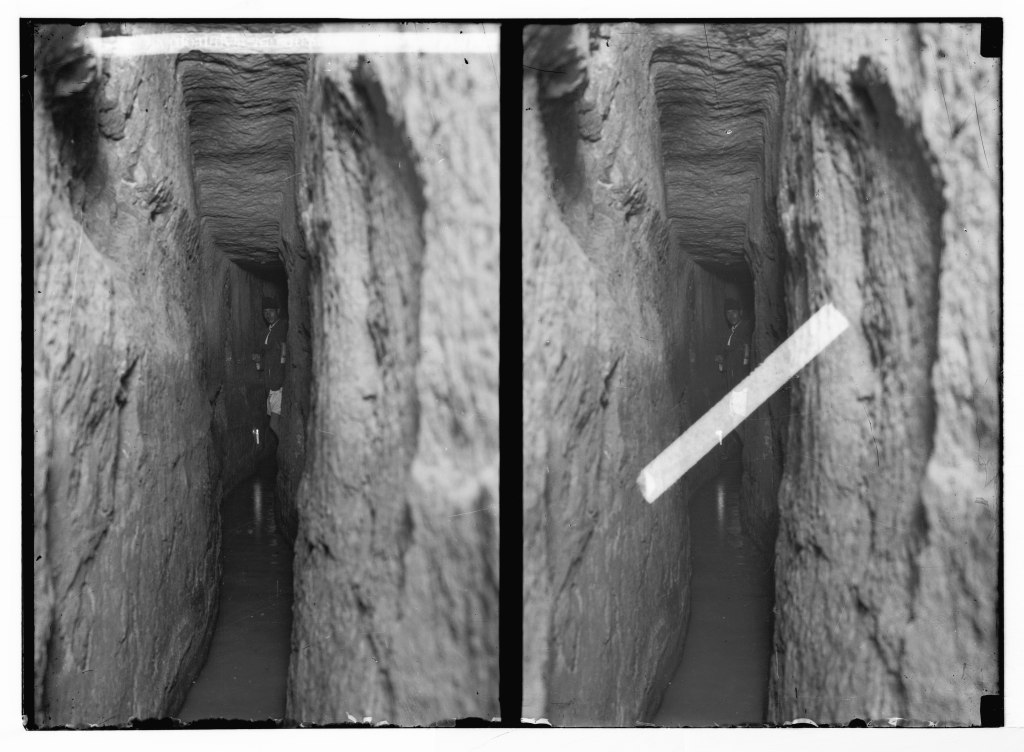
A historic view inside the Siloam Tunnel in Jerusalem. Photograph from the G. Eric and Edith Matson Photograph Collection, Library of Congress. Public domain; no known restrictions on publication.
A City Facing a Powerful Enemy
To understand why an underground waterway mattered, we must return to the late eighth century B.C., when the Assyrian Empire was extending its control across the ancient Near East. In 701 B.C., King Sennacherib campaigned across Judah—an event preserved in both Assyrian royal records and the Bible.
Jerusalem depended on the Gihon Spring, located along the city’s eastern slope. In a time of peace, the spring sustained life. During a siege, access to water could determine whether a city endured or fell.
Second Chronicles places King Hezekiah of Judah in precisely such a crisis. When he realized that Sennacherib intended to attack Jerusalem, he consulted his officials about stopping the water sources outside the city so they would not aid the invading army.
Later in the same chapter, Scripture records:
“This same Hezekiah also stopped the upper watercourse of Gihon, and brought it straight down to the west side of the city of David.” — 2 Chronicles 32:30, KJV
Second Kings also remembers Hezekiah for “how he made a pool, and a conduit, and brought water into the city” (2 Kings 20:20, KJV).
The verses do not provide a map or measurements, but they describe a royal project involving the Gihon, a conduit, a pool, and water brought toward the City of David. Beneath that ancient part of Jerusalem is a tunnel that closely matches that description.
An Engineering Achievement Beneath the Rock
The Siloam Tunnel follows a curving route for approximately 533 meters, or about 1,749 feet. Its floor drops only about 12 inches from beginning to end, creating a gentle slope that allows gravity to carry the water toward its outlet.
Its winding path has puzzled researchers for generations; a direct route would have been far shorter. Geological research indicates that the tunnel was deliberately excavated rather than formed by simply enlarging a natural passage. How the workers navigated beneath the city is still debated. Changes in direction remain visible in the rock, and some researchers have proposed that people above ground helped guide the diggers through sound.
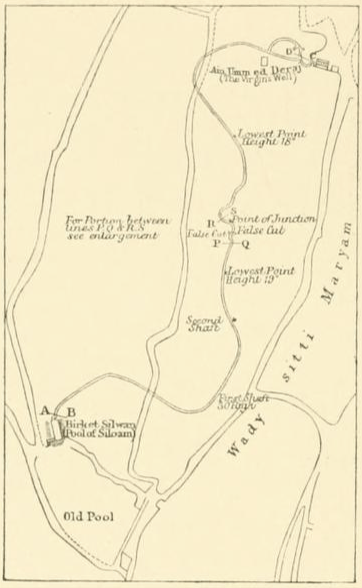
An 1884 plan and section of the winding Siloam Tunnel from The Survey of Western Palestine—Jerusalem. Illustration by Charles Warren and Claude Conder. Public domain.
The Inscription That Preserved the Workers’ Story
In 1880, writing was discovered on a prepared section of the tunnel wall near its outlet. The six-line text, now called the Siloam Inscription, was written in ancient Hebrew script.
It does not celebrate a king. It does not mention Hezekiah, Sennacherib, or an approaching army. Instead, it preserves the human drama of the construction itself.
The inscription describes stonecutters working toward one another. As only a short distance remained, one group heard voices through the rock. Then came the breakthrough—axe meeting axe—and water flowed from the source toward the pool.
The original inscription was removed from the tunnel during the Ottoman period and is now held by the Istanbul Archaeology Museums. Its discovery provided direct written evidence from antiquity explaining how the tunnel was completed
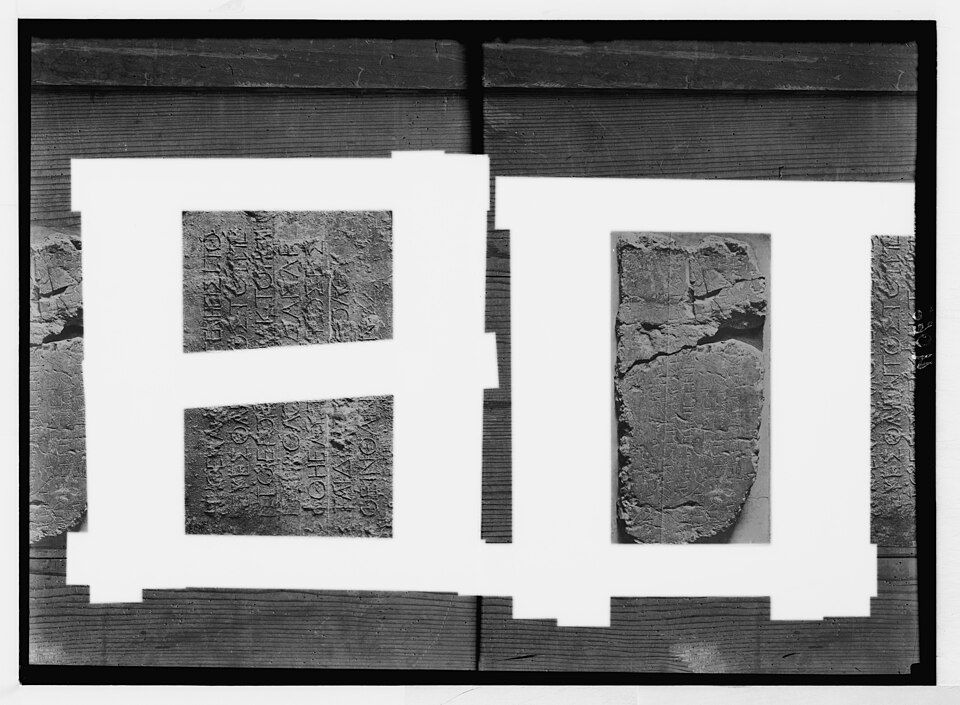
The Siloam Inscription, removed from the tunnel wall and photographed in the early twentieth century. Photograph from the G. Eric and Edith Matson Photograph Collection, Library of Congress. Public domain; no known restrictions on publication.
Dating an Ancient Tunnel
Stone cannot be radiocarbon dated, so researchers had to examine material connected to the tunnel’s construction. In a 2003 study published in Nature, scientists tested plant material and wood fragments preserved in the original plaster, along with mineral deposits that formed after the waterway was built. The results supported an Iron Age date around 700 B.C., consistent with the period traditionally associated with Hezekiah.
In 2011, archaeologists Ronny Reich and Eli Shukron published a reassessment based on excavations near the Gihon Spring and the tunnel’s northern entrance. They proposed that the tunnel may have been completed several decades earlier—possibly before Hezekiah’s reign.
The tunnel is traditionally identified with Hezekiah because its location, function, and approximate date correspond closely with the biblical description. But the Siloam Inscription contains no royal name, and scholars have not reached complete agreement about when the passage was cut. The evidence firmly places the waterway in the world of biblical Judah; archaeology cannot place Hezekiah’s signature on its wall.
Prepared for Battle, Trusting in God
According to Scripture, Hezekiah strengthened Jerusalem, protected its water, and prepared his people. Yet his confidence did not finally rest in stone walls or human engineering.
Facing a far more powerful army, Hezekiah told the people that Assyria possessed only human strength, “but with us is the Lord our God to help us” (2 Chronicles 32:8, KJV).
Preparation and trust were not opposites. Hezekiah did what he could, then placed what he could not control into the hands of God.
Nearly 2,700 years later, water still follows the ancient path beneath Jerusalem, and chisel marks remain in the rock. The tunnel places us inside the physical world Scripture describes—a world of real cities, real threats, real decisions, and real people carving a way forward through the dark.
When the stones are allowed to speak without exaggeration, their testimony is powerful enough.
Sources and Further Reading
- Amos Frumkin, Aryeh Shimron, and Jeff Rosenbaum, “Radiometric Dating of the Siloam Tunnel, Jerusalem,” Nature 425 (2003): 169–171.
- Amos Frumkin and Aryeh Shimron, “Tunnel Engineering in the Iron Age: Geoarchaeology of the Siloam Tunnel, Jerusalem,” Journal of Archaeological Science 33 (2006): 227–237.
- Ronny Reich and Eli Shukron, “The Date of the Siloam Tunnel Reconsidered,” Tel Aviv 38, no. 2 (2011): 147–157.
- “Prism Recording the Campaigns of Sennacherib,” British Museum collection record.
- “The Siloam Inscription,” City of David.
- Biblical references: 2 Kings 18–20; 2 Chronicles 32; Isaiah 36–37.
Scripture quotations are from the King James Version, which is in the public domain in the United States


Leave a Reply